Power performance testing (PPT) relies on accurate wind speed measurements at turbine hub height. In flat terrain, a reference meteorological mast (RMM) positioned upwind of the turbine typically provides representative data. However, in complex terrain, a site calibration measurement is required to correct for variations in wind conditions, necessitating the installation of an additional mast at the turbine location, which is both expensive and impractical prior to turbine construction.
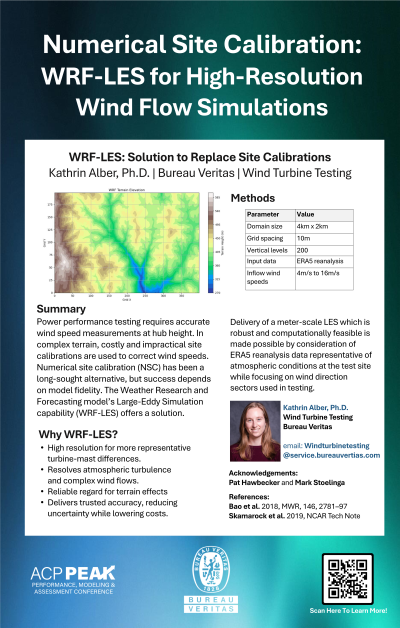
This project explores a cost-effective alternative using numerical site calibration (NSC) through the Weather Research and Forecasting (WRF) model coupled with a large eddy simulation (LES). In this approach, a single high-resolution domain with 10m horizontal grid spacing is used to explicitly resolve small-scale flow structures and turbulence. To optimize computational efficiency, the model domain is rotated and customized for each inflow direction, ensuring sufficient upwind fetch while minimizing the computational burden.
Idealized input soundings are derived from ERA5 reanalysis data with a range of different inflow wind speeds. While WRF-LES offers an advanced modeling technique for wind flow in complex terrain, it is designed to provide a robust and efficient tool for site calibration, ensuring that power performance tests reflect accurate wind conditions at turbine locations.


.png)